Editors Note: Robert C. Randall was the first person to successfully gain legal access to marijuana for medical use in the United States. Bob Randall’s work was a primary reason 33 states, in the late 1970s and early 1980s, enacted legislation recognizing marijuana’s medical value — in many cases through the establishment of state-sponsored research programs; he played a pivotal role in obtaining legal access to medical cannabis for a limited number of other patients before the federal government closed the program to new patients in the mid-1990s. He also was fundamental in advancing the original NORML rescheduling petition to historic hearings before Administrative Law Judge Francis Young. Through these and other accomplishments Bob Randall laid the foundation for the modern medical cannabis reform movement, confronting such issues as the need for legal access for all patients in the United States and the need to distinguish the issue of medical access to cannabis from issues related to recreational use or legalization. Alice O’Leary is the widow of Robert Randall and along with Bob the co-founder of the Alliance for Cannabis Therapeutics (ACT). She currently resides is Sarasota, Florida and is a nurse with Tidewell Hospice and Palliative Care. The following remarks in remembrance of Bob Randall were delivered at the 4th National Clinical Conference on Cannabis Therapeutics, sponsored by Patients Out of Time, in Santa Barbara, California on April 7th, 2006.
Thanks to Al Byrne, Mary Lynn Mathre, and Patients Out of Time for their hard work over the years and for remembering Bob especially in this year of 2006 when there are several milestones: June 2nd will mark the 5th anniversary of his death; November 12th marks the 30th anniversary of his receipt of federal supplies of marijuana for the treatment of his glaucoma; and November 24th will be the 30th anniversary of the decision in his celebrated legal case (U.S. v Randall) which established the legal concept of medical necessity.
It is hard to encapsulate a life in a speech. There are so many aspects of our life together and the more than two decades of work that we devoted to the medical marijuana issue that merit re-telling. In 1998 we wrote our memoirs – Marijuana Rx: The Patient’s Fight for Medicinal Pot – and it took us nearly 500-pages to tell the story of our lives. So as I began preparing this speech I was perplexed about the goal or the focus. But a fairly recent article, part of the lead-up to this conference, gave me guidance. It stated that Bob Randall “unwittingly instigated the modern medical marijuana movement.” If I accomplish anything here tonight I would hope that I demonstrate that Bob’s efforts were anything but “unwitting”. From the first moment that he learned federal officials were aware of marijuana’s therapeutic utility he set his course to defeat the prohibition of marijuana as a medicine.
So I decided to focus on the beginning, the years 1975 to roughly 1980, because it was in those years that the foundation was built for the later successes such as Judge Young’s momentous decision in 1989, the expansion of the Compassionate IND program in the 1990s, or the state initiatives that also came in that decade.
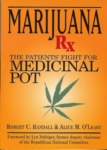
Marijuana Rx, The Patients Fight for Medicinal Pot
by Robert C. Randall and Alice M. O’Leary
I will be using many quotes from our book, Marijuana Rx because so much of that book is in Robert’s own words. And oh, how he loved words. Few people are aware that Robert was a trained rhetorician.
Rhetoric (noun):
- the art of effective or persuasive speaking or writing, esp. the use of figures of speech and other compositional techniques
- language designed to have a persuasive or impressive effect on its audience.
He had a Master’s degree in Rhetoric and relished the process of debate and discussion. After graduation from college in 1971, he went to Washington, D.C. hoping to write great political speeches that would sway hearts, enlighten minds, and perhaps change the course of history.
“We are storytellers to the gods. And the gods like a good story,particularly one of great struggles, battles, blindness, death, and love. The safari of my soul has had all those elements.”
Marijuana Rx, page 3
But the gods had a different plan for Robert and he would find himself presented with an opportunity to change the course of American thought and policy all on his own. He rose to the occasion in a stunningly effective way
There are some here today who knew Robert. Most will recall him as a jovial, middle-age fellow, quick with a joke, extremely articulate (federal officials prefer the term “glib”), focused like a laser beam on the issue of medical access to marijuana, and critical of those whom he felt were using the issue to further the cause of recreational drug use.
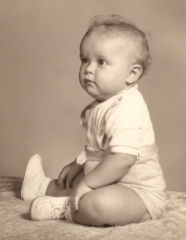
Early portrait of Bob Randall
Robert was born in Sarasota, FL in 1948. As he would later write, “I arrived into Eden, had loving parents, Thelma and Carl, and a grand passage from infancy to literacy.” With his brother Dick and sister Susan he enjoyed a fairly conventional childhood. Bob loved the sun, the beach, cooking out and was even a member of the high school band.
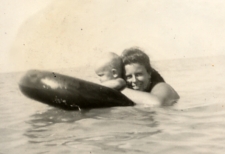 Baby Bob with mother Thelma, 1948 |
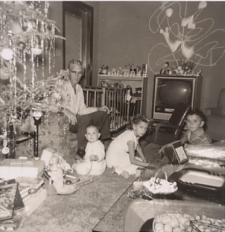 Christmas at the Randall Household |
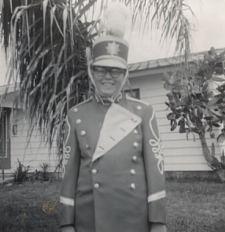
Bob Randall ready to perform with his High School Band